

If you have spent any amount of time learning astrology online, you have probably seen people argue about house systems.
“Whole sign is more accurate.”
“Placidus resonates more.”
“Your chart completely changes when you switch systems.”
“If you have a late-degree rising sign, you should really be using Placidus.”
And honestly? I think this entire conversation becomes much more complicated than it needs to be.
Whole sign and Placidus are not competing to tell two completely different stories about you. They are two different ways of reading the same story.
Think of it like reading the same book in English versus French. The language changes. The sentence structure changes. Certain words carry slightly different shades of meaning. But it is still the same story.
Neither house system is inherently right or wrong, better or worse, good or bad.
They are different tools with different purposes.
And understanding what each system is actually doing makes it much easier to decide when—and why—you might use one over the other.
First: What Do the Houses Actually Represent?
The houses in your birth chart represent the physical areas of your life.
Your relationships. Your money. Your home. Your career. Your community. Your creativity. Your body and lived experience of being you.
The signs describe the energy, lessons, and qualities moving through those areas. The planets describe the parts of you acting within them.
But before we can place any of that into houses, we need a system for dividing the sky.
That is all a house system is: a mathematical and symbolic framework for dividing the chart into twelve areas of life.
Whole sign and Placidus divide that space differently—which means a planet may appear in one house in your whole sign chart and a different house in Placidus.
That does not mean one chart is wrong.
It means the same placement is being viewed through a different lens.
How Whole Sign Houses Work
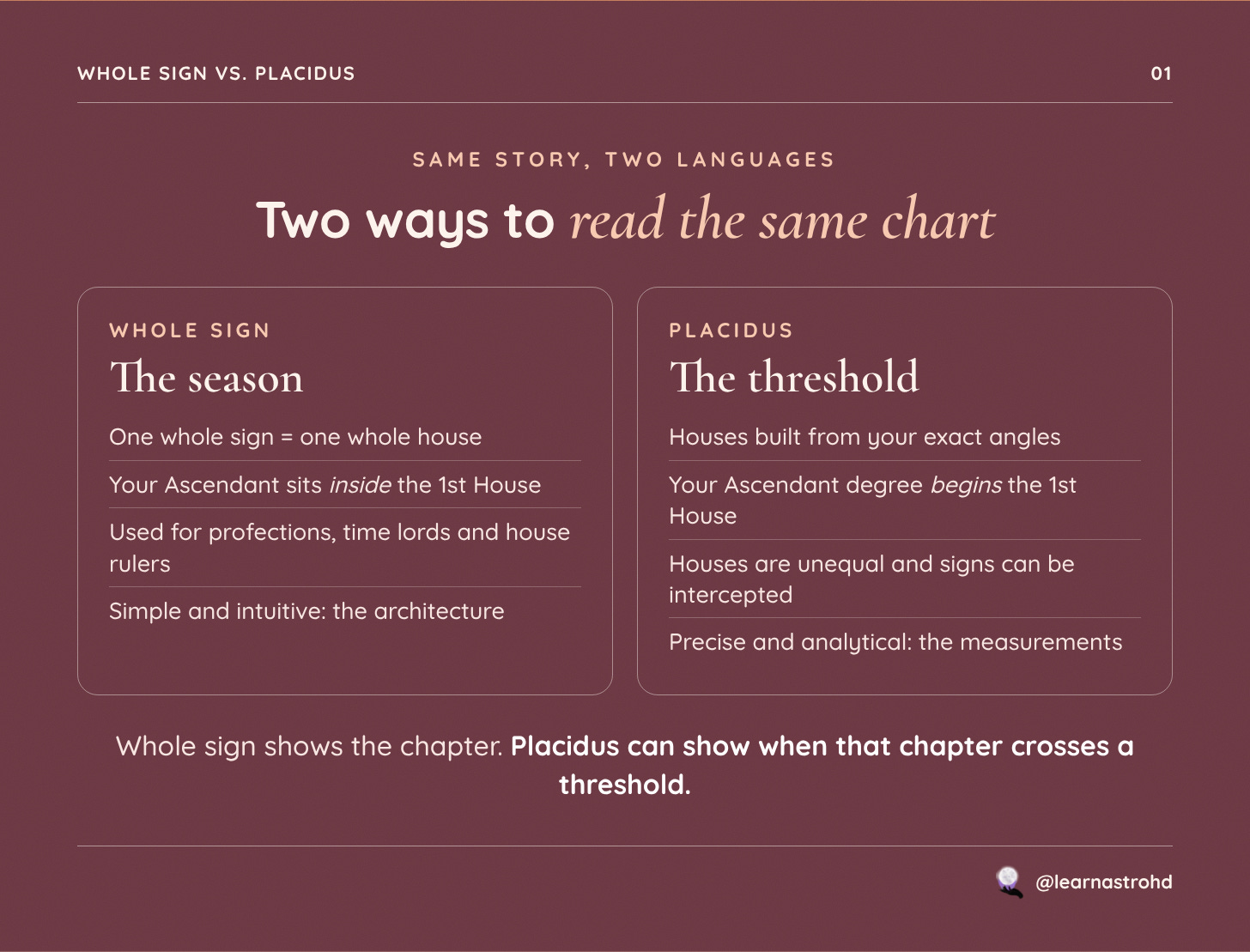
Whole sign is exactly what it sounds like: one whole zodiac sign becomes one whole house.
Whatever sign your Ascendant falls in becomes your entire first house, beginning at 0 degrees of that sign and ending at 29 degrees and 59 minutes. The next sign becomes your second house, the next becomes your third, and so on.
If you are an Aquarius rising, Aquarius is your first house. Pisces is your second. Aries is your third. And when Jupiter moves through Leo, it is moving through your seventh house. Full stop.
Your exact Ascendant degree still matters. It does not disappear. It remains an incredibly sensitive point within the first house, and a planet crossing it can still describe a noticeable shift.
But the Ascendant does not begin the first house in whole sign. It exists inside it.
Whole sign is the oldest widely used house system we have evidence for in the Hellenistic tradition, and it is the system I use when teaching Hellenistic timing techniques.
Annual profections. Time lords. House rulers and dispositors. Connecting the ruler of one area of life to another area of the chart.
These techniques were developed within a whole sign framework, so we need to use whole sign houses if we want to apply them as they were designed.
It is also beautifully simple.
You can know which area of life a transit is broadly activating just by knowing your rising sign. There are no uneven houses to calculate and no ambiguity over whether a planet at the end of a sign has already entered the next house.
Whole sign gives us the broader chapter of the story.
How Placidus Houses Work
Placidus is a quadrant house system based on how points in the sky move through time and space in relation to your specific birthplace.
Although it was popularized in the 17th century by Placidus de Titis, it developed from older time-based approaches to dividing the chart.
In Placidus, the exact degree and minute of your Ascendant become the cusp of your first house. The Descendant begins the seventh. The Midheaven begins the tenth, and the IC begins the fourth.
The space between those four angles is then divided to create the remaining house cusps.
Because of that, the houses are not necessarily equal in size. One house might contain most of a sign. Another might contain pieces of two or even three signs. Depending on your birth location, some signs may not begin a house at all.
This is why switching from whole sign to Placidus can move some of your planets into different houses.
It is also why Placidus can add a level of specificity to timing.
A slow-moving planet may enter a new whole sign house and begin introducing the broader themes of that area of life. Later, when it crosses the exact Placidus cusp—or one of the angles—the experience may become more concrete, visible, or eventful.
I think of whole sign as showing us the overall season.
Placidus can sometimes show us when that season reaches a threshold.
Not every event waits until a planet crosses a Placidus cusp, of course. Astrology is never that mechanical. Aspects, planetary stations, time-lord activations, progressions, and the rest of the chart still matter.
But those exact cusp crossings can be incredibly revealing when we look back at the timing of major life changes.
My Own Experience With Placidus Timing
I primarily use whole sign houses, but some of the most exact transit timing in my own life has shown up through Placidus.
When Venus crossed my Ascendant and entered my Placidus first house, I felt an entire shift in how I was showing up.
I started getting noticed more. I booked a photo shoot. I entered a completely new cycle around my appearance, self-worth, relationships, and the way I allowed myself to be seen.
The larger first-house themes were already available. But Venus crossing that exact threshold made them tangible.
When Pluto crossed my IC and entered my Placidus fourth house in 2014, I decided to move across the country to a state I had never even visited.
Pluto on the IC is not exactly subtle. My roots, home life, and entire inner foundation were being uprooted and rebuilt—and the physical move happened right around that crossing.
When Saturn crossed my Descendant and entered my Placidus seventh house, a long friendship that had quietly stopped being good for me finally ended.
Saturn brought the boundary, the reality check, and the closure right at the threshold of my relationship house.
That is the value I find in Placidus.
It is not telling me a different life story. It is giving me another layer of language—and sometimes a much more precise timestamp for when the next part of the story becomes real.
Now for the part most people get wrong, especially if you have a late-degree rising.
So in today’s paid post, I’m clearing up the confusion for good:
Why your Ascendant and your 1st House are not the same thing
Late-degree rising? The progressed-chart layer nobody mentions
Why Placidus feels analytical and Whole Sign feels intuitive
What intercepted signs actually mean (and whether you need to worry about them)
Which house system to use, technique by technique
A side-by-side exercise to try with your own chart
My full Substack library, including beginner-to-advanced astrology lessons and more
You can keep switching house systems and wondering which one is “right.” Or you can learn exactly when to use each one.
Subscribe to read the full breakdown. 👇
